
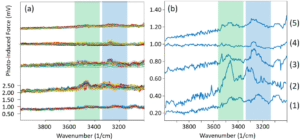
For successful Cu-Cu hybrid bonding to occur in the most demanding advanced packaging, the two mating dielectric surfaces, in many cases silicon oxide, must bond effectively at low temperatures. It is known that hydrophilic silicon wafers can be bonded together easily at room temperature [1]. Hydrophilic silicon surfaces are usually realized by Si-OH termination. However, detecting if a surface is properly prepared can be quite difficult. A less the 0.6 nm layer of physisorbed water has been successfully measured on a clean silicon surface at ~40% relative humidity. This measurement was accomplished by using a silicon substrate as an attenuated total reflection (ATR) crystal, which was prepared so that there would be ~ 35 internal reflections to help increase the SNR [2].
While impressive, this method of measurement isn’t practical for routine measurements. It also is a macroscopic technique averaging over hundreds of microns of sample surface. Another widely used macroscopic technique is a water contact angle measurement. However, it has been shown that there are significant differences between the macroscopic and microscopic hydrophobicity (measured by water contact angle) when there is inhomogeneity on the surface [3]. None of the traditional analytical techniques (EDX, ToF-SIMS, etc.) can reliably detect the presence of such a thin water layer locally. I
In this note, PiF-IR spectra are used to follow the adsorption and desorption of water molecules as a silicon surface ndergoes cleaning and heating procedures.
Learn More?
Please click on ‘Request Application Note’ and download the full application note ‘Measurement of -OH termination on hydrophilic surfaces’.