
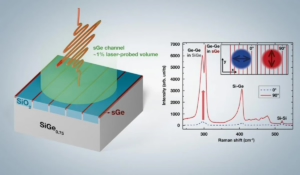
Raman spectroscopy is an essential tool for the characterization of semiconductors as it provides nondestructive,high-throughput, and versatile measurements of various material properties, including stress, composition, and crystalline structure. However, Raman spectroscopy’s spatial resolution is limited by the diffraction limit to about 200-300 nanometers, which can be insufficient for analyzing
the increasingly smaller features of modern electronic devices. This application note aims at showing how it is possible to make use of the resonant coupling phenomenon when the light polarization is aligned with device structures with dimensions much smaller than the incident wavelength [1-6]. This polarization-induced enhancement allows Raman microscopy to reach nanoscale information without hardware modifications of the instrumentation. The nanofocusing mode is achievable by selecting the appropriate arrangement of incident polarization and structure angular orientation. In addition, since the nanofocusing effect is highly dependent on the dimensions of the nanostructure, this phenomenon can also be used to study the dimensions themselves, which is a crucial aspect of semiconductor metrology. The intensity of the obtained signals scales directly with the probed volume at the nanoscale. Nanometer-level sensitivity to dimensions such as the width of semiconductor and metal lines has been shown.
Learn More?
Please click on ‘Request Application Note’ and download the application note ‘How Raman Spectroscopy can measure nanoelectronics structures’.